Simple. Beautiful. Meaningful.
-

Pick Your Plan
Choose a subscription that works for you. You can join the story at any time — every letter is a warm welcome.
-

It Arrives in the Mail
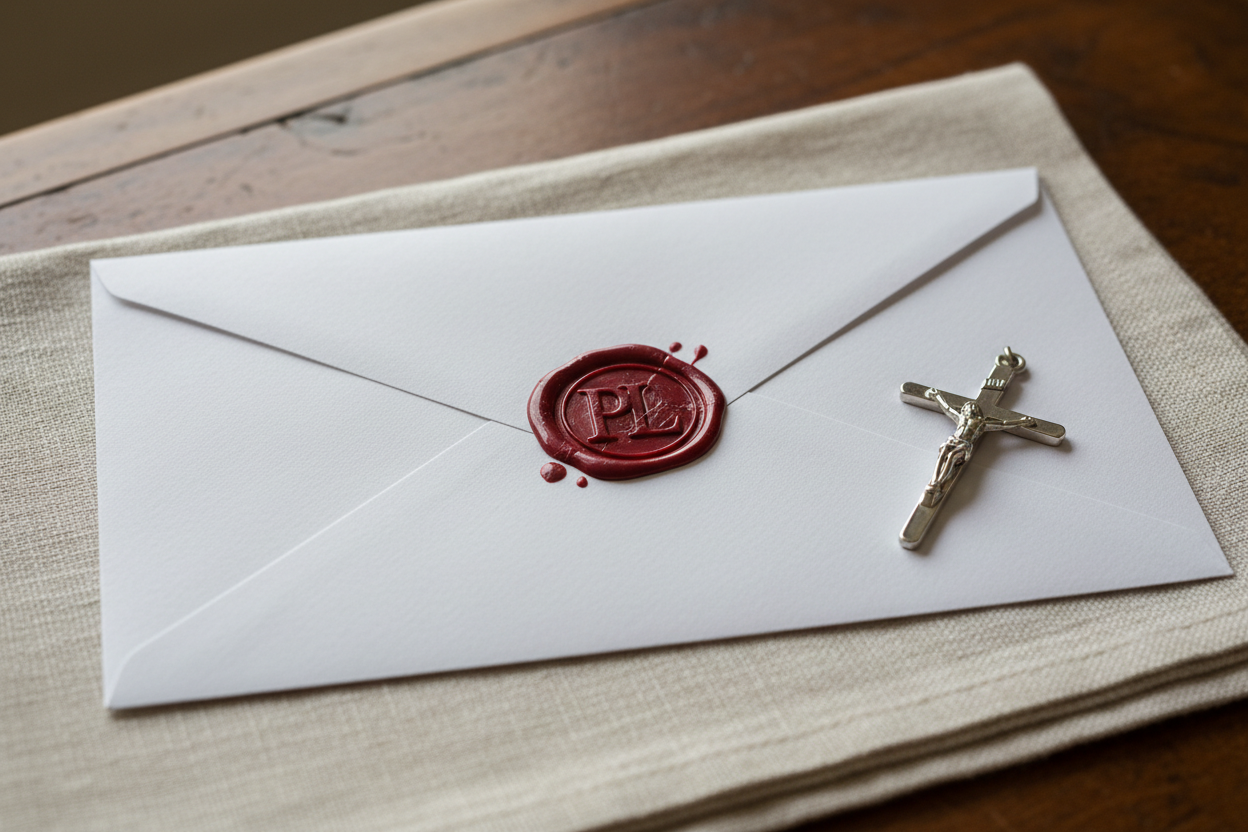
Twice a month, on the 1st & 15th, a handwritten-style letter lands in your physical mailbox — a quiet, beautiful pause in your day.
-

Be Moved by the Story
Each letter unfolds the next chapter of a faith-filled story — full of heart, hope, and the quiet presence of God.


Get Started With Our Feature Story
She stepped out from her small home with her shawl drawn close, her basket resting lightly on her arm. Lightly—but not because it was full. It was light because there was little inside, and even less she expected to carry back.
She paused at the threshold before pulling the door shut behind her. Not because she had forgotten something, but because she always did.
A moment.
A stillness.
A quiet counting.
Not of blessings—not in the way others spoke of them—but of what remained.
A little flour.
A bit of oil.
A few lentils.
Enough, if she was careful. Enough, if nothing went wrong. Enough, if the week did not stretch longer than expected.
Her fingers tightened slightly on the basket’s handle.
“Another week,” she murmured to herself.
It was not quite a prayer. Not quite a complaint. Simply a truth spoken aloud.
Then she turned and began the walk to the market.
The road was familiar beneath her feet, worn smooth by years of passing. Ruth knew every bend, every uneven stone, every place where the dust gathered deeper than it should. She walked it the same way each time—steady, measured, without hurry.
Once, long ago, she had walked this road differently.
Back then, there had been another set of footsteps beside hers.
Eli.
He had filled the silence with easy words and small observations. He noticed things she did not—the way the baker burned his first batch each morning, the way the fig tree near the well leaned just slightly more each year, the way certain merchants would lower their prices if you lingered just long enough without speaking.
Ruth had not needed to think so carefully then.
Eli had carried much of that weight without ever naming it.
Now, the road felt longer.
Not because it had changed—but because everything else had.
The market slowly came into view, waking like a living thing.
Cloth was being shaken out over tables. Wooden stalls creaked as they were set upright. Voices, low at first, began to rise and overlap. A donkey shifted impatiently, its harness rattling. Somewhere, a child laughed, sharp and bright against the softer sounds of morning.
Ruth stepped into it without drawing attention.
She never did.
Her presence was the kind that blended into the edges of things. Not hidden, not invisible—but easily overlooked. And that suited her. There was less expectation that way. Less conversation. Less chance of someone asking a question she did not wish to answer.
“How have you been?”
“Are you managing?”
“Do you have enough?”
Enough.
The word followed her more than people realized.
Ruth moved from stall to stall, her eyes careful, her hands slower still. She did not reach for things immediately. She watched first. Compared. Waited. Prices mattered more than preference. Quantity more than comfort.
At the bread stall, she studied two loaves.
One was round and soft, still warm enough that steam escaped when the baker shifted it.
The other was smaller. Firmer. A day older.
She chose the smaller one.
At the vegetable table, she passed over the bright, straight carrots at the front and instead reached for the ones pushed to the side—crooked, slightly split, imperfect.
“They cook the same,” she whispered to herself.
The seller did not argue.
He had seen her before.
This was how Ruth lived now.
Not in lack exactly—but in carefulness so constant it had become part of her breathing.
Every choice carried a quiet question:
Will this last?
And beneath it, a quieter one still:
Will I?
She did not speak that second question aloud.
Not even in prayer.
There were others in the market who lived with abundance.
It was easy to see them.
They did not count coins twice before handing them over. They did not hesitate between one item and another. Their baskets filled quickly, easily, without visible cost.
Ruth did not envy them.
Not in the way some might expect.
But she noticed.
And noticing, sometimes, was its own kind of weight.
She had nearly finished her buying when she felt it.
Not a sound.
Not a voice.
Something quieter than both.
A pause.
Her hand hovered over her basket as she stood between two stalls. The noise of the market continued around her, unchanged. Nothing had shifted. No one had called her name.
And yet…
She did not move.
It was a strange thing—how stillness could press more firmly than motion.
Ruth frowned slightly, her eyes lowering to the basket at her side.
There was nothing remarkable about it.
Worn reeds. A slight bend along one edge. The handle smoothed by years of use. It had carried food, and sometimes nothing at all. It had known seasons of a little more and seasons of much less.
It was, in every way, ordinary.
And yet the feeling remained.
A quiet interruption.
Ruth shook her head gently, as if to clear it.
“Foolishness,” she murmured.
There was still one part of the market she had not passed through.
The far end.
The quieter end.
She did not need to go there.
There was nothing there she required. No food she could afford. No goods she sought. It would add time to her walk home, nothing more.
And yet…
Her feet began to move in that direction.
The sounds of the market faded slightly as she went.
Not entirely—just enough that individual noises no longer pressed in on her. The laughter grew distant. The calls of the merchants softened. Even the air felt different here—less crowded, less hurried.
The stalls were older.
So were the things upon them.
Objects that had been used, set aside, and brought back again. Items without clear purpose. Pieces of lives that had shifted, changed, or been lost.
Ruth slowed without meaning to.
There was something honest about this part of the market.
Nothing here pretended to be more than it was.
And then she saw him.
The old man.
He sat as he always did—though Ruth could not have said how she knew that, only that the sight of him felt… expected.
His stall was small. Unremarkable. A scattering of items laid out with no clear order. Nothing that called attention. Nothing that invited curiosity.
And yet, he remained.
Still.
Watching.
Waiting.
Not in the way of a merchant eager for coin.
But in a way Ruth could not name.
She stopped a short distance away.
For a moment, neither of them spoke.
The old man’s eyes lifted to hers—not sharply, not suddenly, but as though he had known the exact moment she would arrive.
There was no surprise in his gaze.
Only recognition.
That unsettled her more than anything else.
Ruth’s grip tightened slightly on her basket.
She became aware, all at once, of its weight.
Not heavy.
But not nothing either.
Enough to matter.
Enough to measure.
Enough to keep.
A thought rose, clear and immediate:
You should go.
There was no reason to stay. No need. No purpose she could name.
Another thought followed, quieter but persistent:
Stay.
Ruth did not move.
Between those two thoughts, she stood.
Between reason and something else she did not yet understand.
Between what she had learned through hardship…
…and something that asked her to step beyond it.
The old man said nothing.
He did not call to her.
He did not gesture.
He simply waited.
Ruth’s heart beat a little faster—not with fear exactly, but with the awareness that something small was about to become something more.
She did not yet know what that would be.
Only that it would begin with a choice.
A simple one.
So small it could almost be ignored.
So small no one else in the market would notice.
Her hand slowly moved toward the basket.
Then stopped.
Logic spoke clearly.
You have little.
You need what you carry.
Wisdom preserves. It does not give away what cannot be replaced.
These were not untrue thoughts.
They had kept her fed. Kept her steady. Kept her from falling into a kind of desperation she had seen in others.
But another voice—quieter, deeper—rose beneath them.
Not louder.
Not stronger.
Just… steady.
And what if you are not the one holding all things together?
Ruth swallowed.
Her fingers curled slightly.
Faith, she had learned, did not always feel like peace.
Sometimes it felt like standing at the edge of a step you could not see.
The old man watched her.
The market moved on behind her.
The basket rested in her hand.
And in that moment—small, unnoticed, easily passed over—Ruth understood something without fully forming the words:
This was where it would begin.
Not with abundance.
Not with certainty.
Not with understanding.
But with giving…
…when keeping made more sense.
Her hand moved again.
This time, it did not stop.
And though no one else in the market marked the moment…
Heaven did.

Letters worth savoring.
-A new chapter of a continuing faith story
-Characters shaped by God's love and mercy
-Moments of prayer, wonder, and everyday grace
-Scripture woven naturally into the narrative
-Printed on beautiful, premium paper
"Each letter is a reminder that God is present in the small, ordinary moments — and that faith is always worth celebrating."